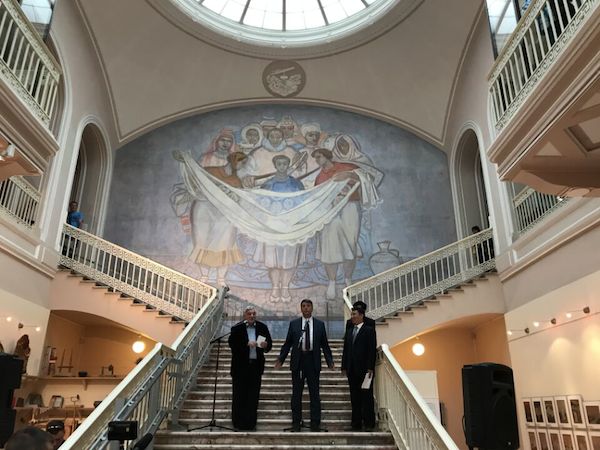
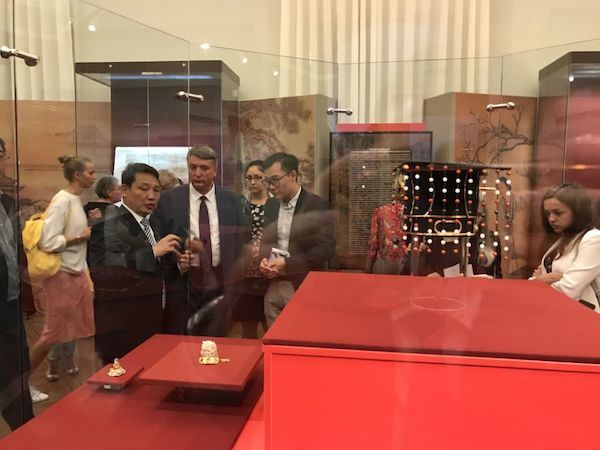
On July 21, the exhibition “Royal Taste: The Art of Princely Courts in Fifteenth-Century China”, co-hosted by the Hubei Provincial Museum, the Ministry of Culture of the Russian Federation, and the Russian Museum of Ethnography, grandly opened at the Russian Museum of Ethnography in St. Petersburg, Russia.
The opening ceremony was moderated by Vladimir Grusman, Director of the Russian Museum of Ethnography, followed by speeches from Alexander Nikolaevich Varenko, First Deputy Chairman of the Culture Committee of St. Petersburg, and Wang Xianfu, Deputy Director of the Hubei Provincial Museum.
This exhibition marks the second collaboration between the two museums, following the 2016 exhibition “The Silk Road and Russian Ethnic Cultural Heritage,” presented by the Russian Museum of Ethnography at the Hubei Provincial Museum.
The exhibition features approximately 90 pieces or sets of cultural relics from the early Ming Dynasty(1368–1644) tomb of Prince Zhuang of Liang, collected by the Hubei Provincial Museum. Exhibits include gold and silver ewers, Jue wine cups, blue-and-white porcelain prunus vases, and lidded gold goblets reflecting the life of Prince Zhuang and his wife, as well as gold and silver coins. Also on display are decorative accessories such as jade belts, belt hooks, gold filigree belt inlaid with gemstones, bracelets, hairpins, hat finials, and gem-inlaid crowns. Religious items related to Tantric Buddhism are also presented, including gold shrine Buddha statues, statues of Mahākāla, Garuda, and talisman plaques.
Starting with an exploration of the life and ceremonial objects of a Ming dynasty prince and his consort, the exhibition showcases the exquisite court art of the early Ming period, highlighting its court rituals, religious beliefs, and aesthetic tastes.
In addition to staff members from the Russian Museum of Ethnography and Hubei Provincial Museum, the opening ceremony was also attended by directors and experts from several museums in St. Petersburg.
Meanwhile, the exhibition attracted the attention of nearly 10 Russian media outlets. St. Petersburg Channel One and Channel 78, as well as Russian Television all conducted on-site interviews.
After learning about the exhibition through early promotions, some local residents of St. Petersburg came to the venue immediately and visited the exhibition halls right after the opening ceremony.
In the coming weeks, the Russian Museum of Ethnography will promote the exhibition through a variety of channels, including publicity campaigns in metro stations. The exhibition will run until October 21.
This exhibition represents a successful collaboration in cultural exchanges between China and Russia, as well as a dialogue between Russian ethnic culture and traditional Chinese culture. It has created an opportunity for the Russian people to gain a deeper understanding of Chinese ritual systems and aesthetic arts. We hope that through this exhibition, the Russian people will deepen their understanding and appreciation of Chinese culture, and that cultural exchanges and cooperation between the two countries will be further strengthened.